




A good rollator walker can be the difference between staying home and getting out to the shops, the park or a coffee with friends. But with compact indoor frames, rugged outdoor models, carbon fibre travel walkers and 2-in-1 transit chairs all on the market, choosing the right one can feel overwhelming.
The simplest way to narrow it down is to start with one question: where will you use it most?
This guide walks you through the indoor vs outdoor decision, the features worth comparing, how to get the right fit, what a rollator walker costs in Australia, and how funding through the NDIS, My Aged Care and DVA can help. By the end, you’ll know exactly what to look for and what to ask before you buy.
Indoor or Outdoor? Start With Where You’ll Use Your Rollator Walker
Most people choose a walker based on looks or price. A better approach is to picture a normal week and think about where the walker will actually go.
Ask yourself:
- Will I mainly use it at home? Think hallways, kitchens, bathrooms and carpet.
- Will I take it outside most days? Think footpaths, driveways, grass, gravel and kerbs.
- Will it travel in the car? Think boot space and how much you can comfortably lift.
- Do I need to sit and rest? Think long shopping trips, queues and walks to the bus stop.
Your answers point you towards one of three broad categories:
| Category | Best for | Typical features |
|---|---|---|
| Indoor walker | Home use, tight spaces, carrying meals | Small wheels (around 6″), narrow frame, tray |
| Outdoor rollator | Footpaths, parks, shopping, uneven ground | Larger wheels (8″ or more), strong brakes, seat and backrest |
| All-rounder | Mixed use and travel | Lightweight frame, easy fold, sometimes 2-in-1 |
Once you know your main environment, the rest of the decision gets much easier. Let’s look at each option in more detail.
Indoor Walkers: Compact Frames for Tight Spaces at Home
Indoor walkers are built for manoeuvrability. Australian homes often have narrow hallways, tight bathroom doorways and small kitchens, and a bulky outdoor rollator can struggle in these spaces.
What makes a good indoor walker:
- Smaller wheels (around 6″) that turn easily and suit flat floors, tiles and low-pile carpet
- A narrow frame that fits through internal doorways without scraping knuckles or door frames
- A tight turning circle so you can manoeuvre around furniture and in the bathroom
- A tray or basket so you can carry a cup of tea, a meal or your phone from room to room safely
That last point matters more than many people expect. Carrying a hot drink while using a walking aid is a common cause of spills and falls. A meal tray walker, such as the Aspire Meal Tray Walker, or a dedicated indoor model like the TrustCare Let’s Go Indoor Rollator, which comes with a bag and tray, solves this neatly.
Tip: Before buying, measure your narrowest doorway (often the toilet or bathroom) and compare it with the walker’s overall width. Leave a few centimetres either side for your hands.
Indoor walkers are generally not designed for rough outdoor surfaces. If you plan to head out regularly, you’ll want to look at outdoor rollators too.
Outdoor Rollators: Bigger Wheels for Footpaths, Grass and Uneven Ground
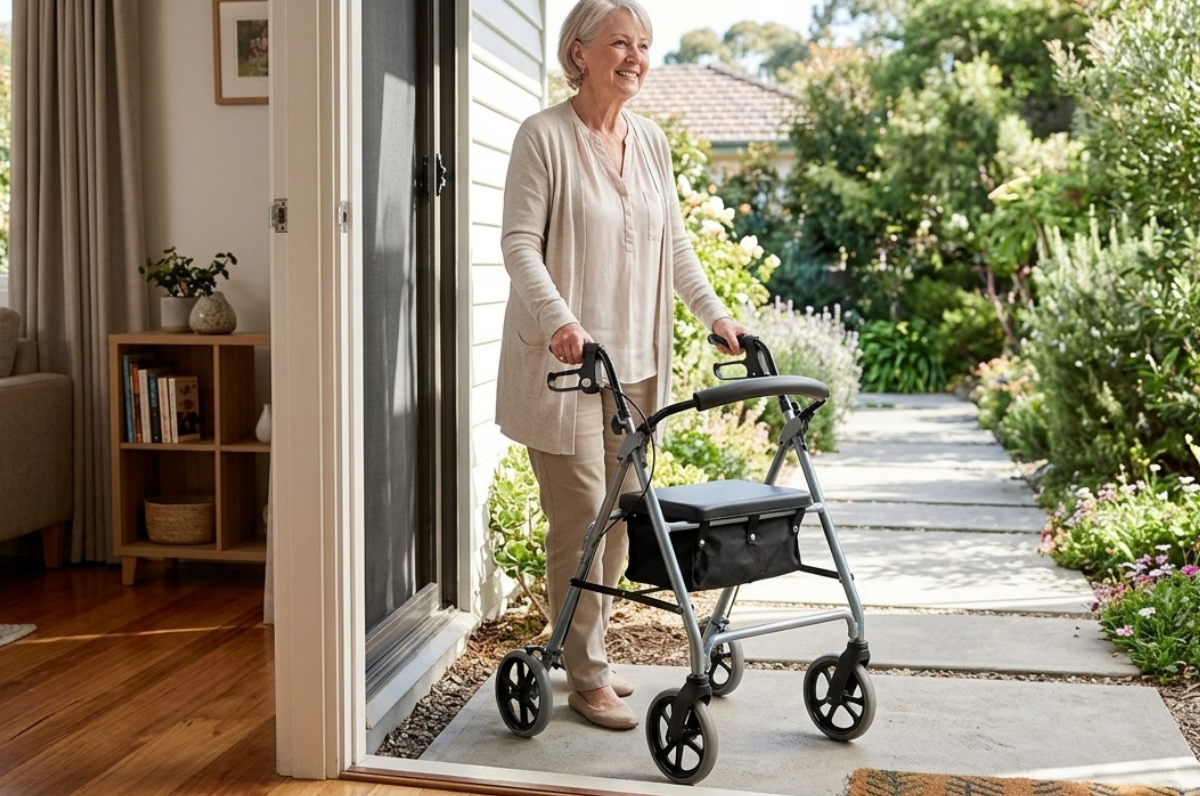
Australian footpaths are rarely perfectly smooth. Cracked concrete, tree roots, kerb ramps, gravel paths and grassy parks all demand a sturdier walking aid. That’s where an outdoor rollator comes in.
What makes a good outdoor rollator:
- Larger wheels (8″ or more) that roll over cracks, bumps and grass more smoothly than small wheels
- Reliable hand brakes with a lockable parking position, so the rollator stays still when you sit down
- A comfortable seat and backrest for rest breaks on longer outings
- Suspension or soft tyres on premium models to absorb bumps and reduce wrist strain
- A storage bag or basket for shopping, a water bottle or a cardigan
Models like the Trust Care Let’s Go Out Outdoor Rollator, which includes a bag and backrest, or the Airgo eXcursion range are designed with these outdoor demands in mind. For shoppers, a rollator with a large integrated bag, such as the Trust Care Let’s Shop or the Comfort Move Carlett, doubles as a shopping trolley.
Tip: If you live somewhere hilly, pay close attention to the brakes. Test that you can squeeze and lock them comfortably, especially if you have arthritis or reduced grip strength.
Outdoor rollators are sturdier and often heavier, which brings us to a common dilemma: what if you need both?
Can One Rollator Walker Do Both? Lightweight, Folding and 2-in-1 Options
Many people move between home, the car and the shops in a single day. For them, a versatile all-rounder often makes more sense than owning two walkers.
Options that bridge indoor and outdoor use:
- Carbon fibre and lightweight walkers. Models such as the Aspire Vogue Carbon Fibre Super Lightweight Walker or the Space Lite Carbon Fibre Walker are easy to lift into a car boot while remaining sturdy enough for outings.
- Double-fold and compact-fold designs. The Uplivin Trive Double Fold Walker and EZ Fold N Go models fold into a smaller package, ideal for small cars, cafes and travel.
- 2-in-1 transit rollators. Walkers like the DAYS 2 in 1 Transit Rollator or the REDGUM CrossOver convert into a transit chair, so a carer can push you when you get tired. These are great for longer outings like medical appointments or shopping centres.
- Dual purpose rollators. The Airgo Fusion combines rollator and transport chair functions in one frame.
Who these suit best:
- People who drive or are driven regularly
- Travellers and those who fly or take public transport
- People whose stamina varies from day to day
- Carers who need a backup option when walking gets too tiring
The trade-off is usually price. Lightweight and convertible models sit at the higher end, but for many people, one versatile walker is better value than two specialised ones.
Key Features to Compare Before You Buy a Rollator Walker
Whatever category you lean towards, use this checklist to compare models side by side.
Brakes
- Are they easy to squeeze with your grip strength?
- Do they lock into a parking position?
Seat
- Is the seat height comfortable to sit on and stand up from?
- Is it wide enough, and is there a backrest?
Frame weight
- Can you (or your carer) lift it into the car comfortably?
- Lightweight models are often under 6 kg, while sturdy outdoor models can be noticeably heavier.
Folding style
- Does it fold side to side or front to back?
- Can you fold it with one hand, and does it stand upright when folded?
Wheels
- Small wheels suit smooth indoor floors.
- Larger wheels suit footpaths, grass and uneven ground.
Storage
- Is there a bag, basket or tray?
- Is the storage easy to reach and secure?
Adjustability
- Do the handles adjust to your height?
- Can the seat height be adjusted on some models?
Accessories
- Cup holders, cane holders, trays, backrests and weatherproof bags can make daily use more convenient. Many can be added later as your needs change.
How to Measure Handle Height and Check Weight Capacity
A rollator walker that’s the wrong height can cause back, shoulder and wrist pain, and may even increase your risk of a fall. Getting the fit right is simple.
How to measure handle height:
- Wear the shoes you usually walk in.
- Stand up straight with your arms hanging relaxed by your sides.
- Ask someone to measure from the floor to the crease of your wrist.
- That measurement is roughly your ideal handle height.
- When holding the handles, your elbows should have a slight, comfortable bend.
Choosing the right frame size:
Many rollators come in small, medium (or regular) and tall versions. As a general guide:
- Small or short frames suit shorter users and often have a lower seat height, making it easier to sit with feet flat on the floor.
- Medium or regular frames suit most average-height adults.
- Tall frames suit taller users who would otherwise stoop over the handles.
Always check the manufacturer’s handle height range against your wrist measurement before buying.
Checking weight capacity:
Every walker has a safe working load (SWL), which is the maximum user weight it’s designed to support. Standard models commonly support around 100 to 136 kg, while heavy duty models like the Mack Rollator are rated to 150 kg.
Tip: Choose a walker with a capacity comfortably above your body weight, especially if you plan to sit on the seat regularly.
How Much Does a Rollator Walker Cost in Australia?
Rollator walker prices in Australia vary widely depending on materials, wheel size, weight and features. Here’s a realistic guide based on current pricing at Able Medilink:
| Price tier | Typical price | What you get |
|---|---|---|
| Economy | About $210 to $300 | Basic steel or aluminium frame, 6″ or 8″ wheels, seat and brakes. Good for occasional or indoor use. |
| Mid-range | About $300 to $650 | Lighter frames, better brakes, adjustable seats, compact folding, bags and trays. Suits regular indoor and outdoor use. |
| Premium | About $650 to $910+ | Carbon fibre or ultra-light frames, suspension, larger all-terrain wheels, shopper bags, backrests and 2-in-1 designs. |
What the extra spend buys you:
- Less weight, which matters if you lift it into the car often
- Smoother rolling over rough ground and less vibration through your wrists
- Better folding, which saves time and frustration every day
- Comfort features like padded seats, backrests and ergonomic handles
- Durability for daily outdoor use
The best value isn’t always the cheapest walker. A rollator you enjoy using every day is worth more than a bargain that stays in the garage.
Common Mistakes When Choosing a Rollator Walker
Avoid these common pitfalls to make sure your new walker is safe and genuinely useful.
- Buying a walker that’s too heavy to lift. A sturdy outdoor model is no help if you can’t get it into the car boot. Consider who will be lifting it and how often.
- Getting the wrong height. Handles set too low cause stooping, and handles set too high strain your shoulders. Measure first.
- Ignoring door widths and turning space. A wide outdoor rollator may not fit through your bathroom door or around the bed.
- Choosing small wheels for outdoor use. Six-inch wheels can catch on cracks and get stuck in grass.
- Skipping the brake check. If you can’t comfortably squeeze and lock the brakes, the walker isn’t safe for you, no matter how good it looks.
- Sitting on the seat while being pushed. A standard rollator seat isn’t a wheelchair. If you need to be pushed, choose a 2-in-1 transit model designed for it.
- Buying online without advice. Photos can’t tell you how a walker feels in your hands. Expert fitting makes a real difference.
Funding Options: NDIS, My Aged Care and DVA Support for Walking Aids
Many Australians are eligible for help with the cost of a rollator walker. Funding rules change from time to time, so it’s always worth checking the latest guidelines with your provider, but here’s an overview of the main pathways.
NDIS
- Participants can use assistive technology funding in their plan for mobility aids.
- Lower-cost, low-risk items like most rollator walkers can often be purchased with less paperwork than complex equipment.
- An occupational therapist (OT) or physiotherapist recommendation helps confirm the walker suits your needs and goals.
My Aged Care
- Older Australians receiving government-funded aged care at home may be able to access assistive technology funding for walking aids.
- Start by contacting My Aged Care for an assessment, or speak with your care provider about what your current funding covers.
DVA (Department of Veterans’ Affairs)
- Eligible veterans may be able to access mobility aids through DVA’s Rehabilitation Appliances Program.
- A clinical assessment from a GP, OT or physiotherapist is usually required.
How to get started:
- Book an assessment with an OT or physiotherapist.
- Ask them to recommend a walker type and any must-have features.
- Request a written quote from your supplier. At Able Medilink, you can use the Add to quote button on any product page.
- Submit the quote to your funding body or plan manager.
Try Before You Buy: Getting Expert Advice From a Local Mobility Specialist
No guide can replace the experience of actually pushing a walker, testing the brakes and sitting on the seat. That’s why speaking with a local mobility specialist is one of the smartest steps you can take.
What expert advice gives you:
- A proper fitting so the handle and seat heights suit your body
- Hands-on comparison of indoor, outdoor and lightweight models
- Honest guidance on which features you need and which you can skip
- Quotes for NDIS, My Aged Care or DVA funding prepared quickly and accurately
- Ongoing support for adjustments, accessories and servicing
At Able Medilink, our team helps Australians find walking aids that genuinely suit their homes, routines and goals. Whether you need a compact walker for the hallway or a rugged rollator for the local park, we’ll help you choose with confidence.
Final Thoughts
Choosing the right rollator walker comes down to a few key decisions:
- Indoor walkers suit tight spaces, smooth floors and carrying meals safely.
- Outdoor rollators suit footpaths, grass and longer outings, with bigger wheels and a comfortable seat.
- Lightweight, folding and 2-in-1 models suit people who move between home, car and shops.
- Fit matters. Measure your wrist height and check the safe working load.
- Budget wisely. Prices range from around $210 to over $900, and extra spend usually buys lighter weight, better folding and more comfort.
- Explore funding through the NDIS, My Aged Care or DVA before you buy.
Ready to find your perfect rollator walker? Browse the Able Medilink rollator and walker range to compare indoor, outdoor and lightweight models, or use Add to quote to request pricing for your funding provider. Have a question about fit or features? Get in touch with our friendly team for personalised advice and support at every step.